End User Statement
At PMI, we design and manufacture high performing, high reliability RF and Microwave products for mission-critical applications. Due to the precision and outstanding capabilities of our products, many may subject to export regulations. These regulations are very important, and they ensure sensitive technology is properly managed but can add paperwork, lead times, and restrictions for international customers. In the paragraphs ahead you’ll learn why export licensing exists, how our products are classified, and how to streamline the whole process.
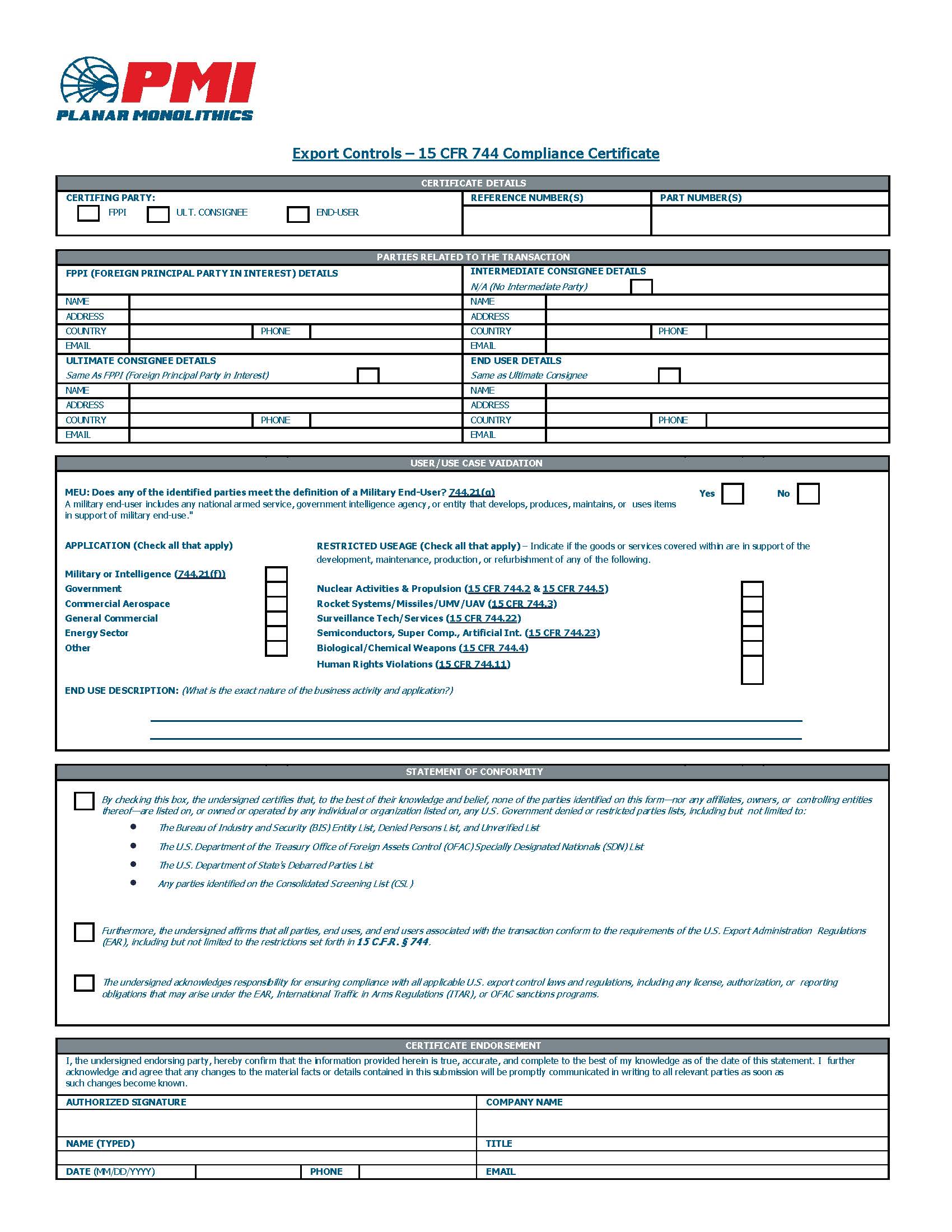
Click the image below to view a full-sized PDF version. Left click on the images below to save the PDF target file.
Completed forms can be emailed to sales@pmi-rf.com or upload using the Contact Us.
Understanding Export Classifications and Regulations
Export regulations classify frequency control and timing products based on their technical specifications and potential applications. Our products fall under both EAR (Export Administration Regulations) and, in some cases, ITAR (International Traffic in Arms Regulations) due to their defense-related uses.
- 34001.b.4.b (40GHz LNAs) / 3A001.B.2.D (SSPAs) – Covers high-frequency devices making them subject to EAR export controls due to potential military and aerospace applications. ITAR Controls – If a product is customized for a defense application, it may be classified under ITAR and require additional licensing through the U.S. Department of State.
- Schedule B – These classifications are used for customs and trade reporting, ensuring accurate documentation for international shipments. ITAR Controls – If a product is customized for a defense application, it may be classified under ITAR and require additional licensing through the U.S. Department of State.

- License Exception GBS (Group B Countries) – Some exports to approved allied nations may qualify for this exception, simplifying the licensing process. However, ITAR-controlled products are not eligible and require a specific export license.
When You Need an Export License (And How to Get One)
Export licenses are required for certain destinations or when exporting dual-use items. Licenses are also required based on the end-use and end-user restrictions.
- Classify your product– Determine if your product needs a license by checking its classification under the Export Control Classification Number (ECCN) via the Bureau of Industry and Security (BIS) guidelines.
- Submit application– Apply through systems like SNAP-R, for EAR-controlled products, or the DDTC’s Defense Trade Controls for ITAR-controlled items.
- Review– Government agencies, like BIS or DDTC, review the application for compliance with U.S. export laws.
- Timeline– Processing can take weeks to months, depending on complexity and additional scrutiny. Typical timelines are outlined on the BIS Processing Times page.
We require an End-Use Statement (EUS) for ALL exports to verify the recipient, application, and final destination. Customers must provide end-user details, the intended application, and assurance that or frequency control and timing products won’t be re-exported to restricted entities. Delays often occur due to incomplete information, flagged end-users, or inconsistencies in documentation. Submitting a clear and accurate EUS helps expedite approvals.
We Make Export Compliance Easy
To ensure a smooth ordering process, it’s essential that our customers work with us to ensure export classification compliance before placing an order. Coordinating closely with us to double-check shipping information and destination details helps prevent delays, as any discrepancies can cause holdups in processing. Additionally, confirming with us the end-use compliance of our products is crucial to avoid any violations of export laws.
We make it easier for international customers by providing support throughout the entire export process! This includes assisting with frequency control and timing product classifications, managing required paperwork, and addressing any regional regulatory questions. We take all the necessary steps to ensure that customers are well supported and remain compliant with the relevant export regulations.